Screens: A source of conflict or connection?
Disconnect to reconnect: Managing screen time together
Screens: A source of conflict or connection?
Disconnect to reconnect: Managing screen time together
For teenagers, screens are both an integral part of daily life and a frequent source of conflict with their parents. But it doesn’t have to be that way. When used mindfully and as a family, screens can become a point of connection, a topic of discussion, and even a pathway to togetherness and digital well-being. Instead of just focusing on screen time, think about how you can develop healthy screen habits together.
In collaboration with PAUSE

Approach the conversation with curiosity
Does this sound familiar? You look up from your own phone only to tell your teen that they’re spending too much time on theirs. Suddenly, the mood shifts, and battle lines are drawn. On one side is a worried parent trying to set limits. On the other is a teen who sees their parent as overbearing and intruding.
The most common mistake? Coming in combative without realizing it. Talking about the “real world” versus the “virtual world” sends an implicit message: that what your teen does online isn’t important. If you lead with the assumption that screen use is a waste of time, then you’ve shut the conversation down before it can start.
So, what works?
🧐Starting from a position of genuine curiosity before laying down the rules.
🤔Accept that you don’t know everything and let your child explain their viewpoint.
📱Ask them: “What do you do on your phone?” “What do you like about it?”
And above all: share your own experiences and questions about screens, without lecturing. After all, we’re all in the same boat. This doesn’t stop you from addressing real risks, without fear-mongering, using concrete examples from your teen’s daily life. It’s perfectly valid to say, “I’m worried because I’m your parent.” The important thing is to be honest without being alarmist.

CHECKING IN TOGETHER ABOUT OUR SCREEN USE
Before talking to your teen about screen use, it’s a good idea to take stock of your own usage. How many times a day do you look at your phone for no specific reason? Are screens interfering with sleep, meals, or family time?
Take a few minutes to answer the following questions with your teen. If approached without judgment, they can spark an honest dialogue and mutual reflection.
Use the interactive version below, or print out the following worksheet:
Download our printable quiz5 questions for you and your teen to explore together🙋🙋♂️
Start👨👦 Taking action together: Helpful habits to adopt as a family
The most effective rules aren’t the ones we dictate, but the ones we model. What we do with our screens on a daily basis has as much an impact on teenagers as what we tell them to do. Think of it as leading by example: For teens, seeing a parent or adult consistently put their phone face-down at dinner, switch to Do Not Disturb at night, and admit they struggle, too, speaks volumes more than any rule you could set.
And it works both ways. Parental screen use habits are one of the strongest predictors of children’s screen use, more so than rules, discussions, or restrictions. In the same vein, technoference, namely parental screen use in the presence of a child, is a predictor of problematic device use in teens. Parents often don’t even realize it’s a problem. In fact, they tend to defend their own screen use while condemning their child’s.
The data bear this out: Nearly one in four adults exceeds the 4-hour threshold for leisure screen time per day. Seeing a parent following the same rules on screen use is more impactful than a thousand conversations could ever be.
Here are a few habits to adopt as a family—not as rules imposed on your teen, but as shared commitments:
- Check your screen time in your settings together, without judgment.
- Disable non-essential notifications on all devices.
- Challenge yourself not to use your phone for a meal or an evening.
- Avoid screens for at least 1 hour before going to bed and turn on Do Not Disturb mode.
- Plan more screen-free activities with your family/teen.
🧾In brief…
The goal is not digital perfection, but digital well-being. It’s about creating a space, in dialogue with your child, where your can talk about screens, what they add to your life, and what they take away from it, all without conflict. Start small, take things at your own pace, and focus on what works for you. Having that conversation is, in itself, an act of connection.
Additional resources:
– PAUSE: Family Screen Use Agreement
– leciel.ca: workshops, resources, and tips
– Hotlines: Kids Help Phone | Tel-jeunes parents
– Infos Santé 811
– Your local CISS or CIUSSS
– Health care profesionals
Discover our tools

Building a better relationship with your teen through mentalization
Through concrete examples of situations at home, discover how to apply mentalization, a super-effective tool for cultivating healthy relationships with others and with yourself.
Watch video
Silent education
Learn more about your influence over your teen’s behaviour and decision-making.
Read article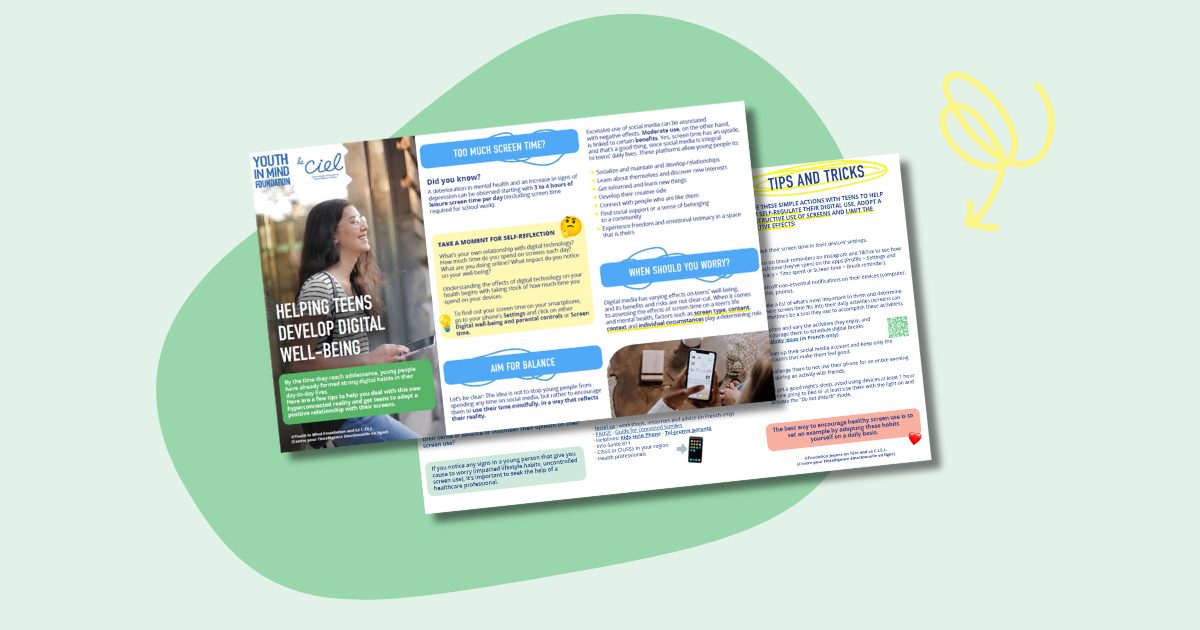
HELPING TEENS DEVELOP DIGITAL WELL-BEING
Here are a few tips to help you deal with this new hyperconnected reality and get teens to adopt a positive relationship with their screens.
Download PDF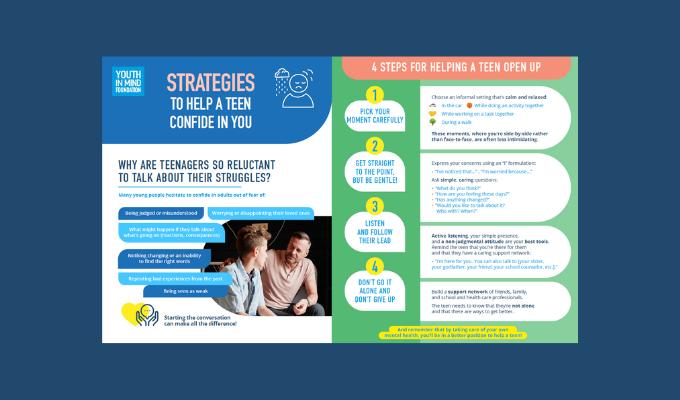
Strategies to help a teen confide in you
Some concrete examples and easy steps for helping a teen open up.
Download PDF
Family toolkit: resources to support a teenager
Here, you’ll find clear information and practical advice to help you support them through this period of change and intense emotions.
Explore our toolkit